
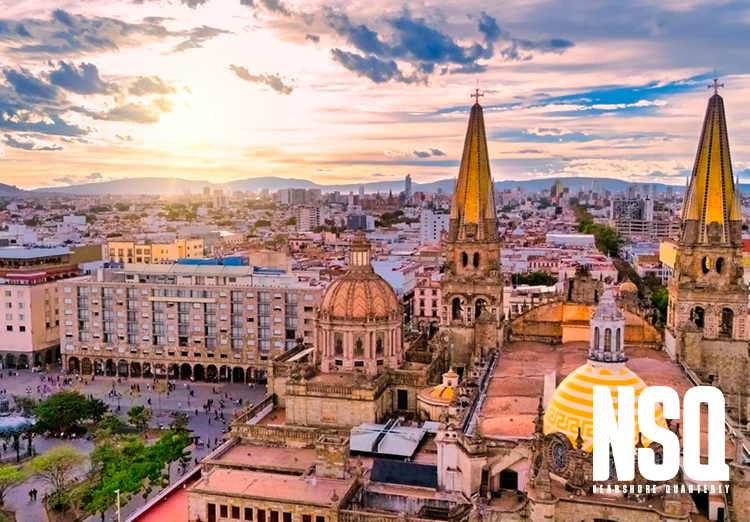
Cities speak. Some say, “move if you can,” others say, “move if you dare”… and then there’s Guadalajara, a city that offers something far more valuable: “move — you’ll get there on time.”
When a CEO evaluates a city for operations — especially one where executives need efficiency, punctuality, and predictable logistics — mobility becomes a decisive factor. It’s not just about traffic. It’s about how much time you lose, how much stress it generates, and how much it affects productivity.
Guadalajara, unlike other large urban centers in Latin America, has a rare advantage: mobility here works. It’s not perfect — no city is — but it’s agile, reasonable, and surprisingly friendly for corporate visitors. Especially if you’re used to moving through Mexico City, Monterrey, Bogotá, or São Paulo.
If you’re considering nearshoring, bringing executives for visits, running a binational operation, or establishing a hub in Jalisco, this matters: getting around Guadalajara won’t drain your agenda, your energy, or your operation.
Let’s break it down clearly.
1. Guadalajara in Real Terms: What It’s Actually Like to Move Around
Guadalajara isn’t small, but it’s not an overwhelming mega-city either. It feels like a modern, growing metropolis — but with a manageable rhythm. Visitors expecting chaos are often surprised to discover how fluid the city truly is.
Executive mobility centers around a compact, well-connected triangle:
•Providencia / Country Club
•Andares / Puerta de Hierro
•Financial Zone (Acueducto – Patria – Puerta de Hierro)
•Midtown / Américas Area
•Av. Vallarta / Minerva Area
And when we talk about nearshoring, corporate offices, and service hubs, this is the map that matters.
The time you spend moving doesn’t depend on crossing the entire city — it depends on moving within these high-performance zones.
2. Key Roads Every CEO Should Know
Guadalajara has several main avenues that act as the backbone of the city. Understand them, and you understand how the city flows.
- Av. Patria
Connects the executive zones: Andares, Puerta de Hierro, Acueducto, Landmark, Providencia. Wide, smooth, and consistently fast.
- Av. Vallarta
Runs east–west and connects the core business district with Zapopan. A straight, efficient corridor.
- Av. Américas
One of the most reliable avenues in the city. It rarely congests and cuts through premium corporate and residential areas.
- Periférico
Perfect for long-distance moves, industrial visits, and airport routes.
- Av. Acueducto
A favorite among corporate offices and executives. Clean, modern, and with constant flow.
- Av. López Mateos (for reference only)
A more congested avenue during rush hours — but the good news is that nearshore operations rarely depend on it.
3. Real Travel Times — Not Theoretical, Actual Daily Experience
This is where Guadalajara outperforms its regional competitors.
Providencia → Andares / Puerta de Hierro
10–14 minutes
Rush hour: 15–20 minutes
Puerta de Hierro → Valle Real / Periférico
8–12 minutes
Midtown → Andares
12–15 minutes
Minerva → Andares
14–18 minutes
Executive Zone (Patria–Andares) → Airport
35–42 minutes
Rush hour: 45 minutes to 1 hour
Hotel → Nearshore office (within the corporate triangle)
7–15 minutes
The conclusion is simple:
transportation doesn’t destroy your schedule.
For CEOs, directors, and executive teams, mobility like this changes the entire operational
landscape.
4. Comparison: Guadalajara vs. CDMX, Monterrey, Bogotá, and São Paulo
To understand Guadalajara’s advantage, you have to see it in context.
Mexico City (CDMX)
•8 km can take 45–90 minutes
•Traffic is unpredictable
•Schedules become rigid by necessity, not choice
For executive operations, CDMX slows down even the best-run organizations.
Monterrey
•Better than CDMX, but with heavy bottlenecks (Gonzalitos, Constitución)
•Longer distances
•Rush hours hit hard
Guadalajara feels more compact and consistently smoother.
Bogotá
•One of Latin America’s most congested cities
•5 km can easily take 40+ minutes
•Mobility becomes a structural challenge
Guadalajara wins by a massive margin.
São Paulo
•Huge, sprawling, and unpredictable
•Executive movement is complex and time-consuming
•Even premium areas suffer from gridlock
Compared to São Paulo, Guadalajara feels almost engineered for business mobility.
Bottom line:
Guadalajara offers speed, stability, and predictability.
And that is exactly what an executive operation needs.
5. Practical, Reliable Transportation Options for Executives
You don’t need to be a local to move efficiently. Guadalajara’s mobility options are simple, safe, and executive-friendly.
- Uber (the corporate king)
•Available everywhere
•Reasonably priced
•2–5 minute arrival times
•Drivers are familiar with executives and foreign visitors
It’s the preferred option for short and medium trips.
- Private Corporate Transportation
Ideal for C-level visits, investor meetings, or structured agendas.
Benefits:
•Professional drivers
•Executive vehicles
•Strict punctuality
•Discretion
Widely used by U.S. and Canadian firms visiting nearshore teams.
- Executive Vehicles (Sedan or SUV)
For teams traveling with equipment, luggage, or needing a formal environment.
Common uses:
•Airport transfers
•All-day driver service
•Multiple-office tours
Reliable and comfortable.
- Car Rentals (usually unnecessary)
Possible, but not needed for 90% of executives.
Distances are short enough that Uber solves everything.
6. What Nearshore Teams Gain from This Mobility
In many cities, transportation is a productivity killer.
In Guadalajara, it becomes a competitive advantage.
- Less time commuting = more time producing
A team that spends 15 minutes commuting works better than one spending 90.
- Less stress = sharper performance
Moving without chaos changes the mindset.
- Better punctuality = real leadership
Meetings start on time.
Schedules become predictable.
- Executive visits are painless
A U.S.-based CEO can fly in, meet the team, tour offices, and return without losing days to
traffic.
- Agility becomes part of your DNA
A city with functional mobility supports fast-paced business.
7. Why Mobility Matters in a Nearshore Strategy
When evaluating a nearshore destination, companies look at talent, cost, infrastructure, and
security.
But one element is often underestimated: daily logistics.
Guadalajara offers an equation very few cities can match:
•short distances
•functional arteries
•reliable transport options
•real travel times
•minimal friction
•consistent flow
For any CEO, that translates to one thing:
Your team can work without losing time to transportation.
Conclusion: Guadalajara Lets You Work —
Not Fight Traffic
Some cities require you to survive traffic before you can start working.
In those places, schedules are fragile, stress is constant, and productivity suffers.
Guadalajara is not one of those cities.
It’s a place where:
•you move quickly,
•you arrive on time,
•and you stay focused on the business, not the road.
For companies evaluating nearshoring, executive operations, or establishing a service hub,
mobility isn’t a trivial detail. It’s a strategic factor.
And in that regard, Guadalajara overdelivers.
Your team will not just work effectively here —
they’ll work without losing hours, without chaos, and without the daily battle against the
clock.
In a region full of cities competing to attract U.S. companies, Guadalajara stands out for
something that seems simple but is operational gold:
moving around is easy.
And for a CEO, that is logistics turned into peace of mind.
Claudia Vázquez
About the Author